 EN
EN
Superior Contaminant Rejection and Consistent Water Purity
Achieving superior contaminant rejection is critical for large water treatment systems, and advanced reverse osmosis provides unmatched consistency.
How Industrial RO Membrane Achieves >99.5% Salt and Micropollutant Rejection at Scale
Industrial RO membranes utilize a thin-film composite polyamide active layer engineered to reject over 99.7% of dissolved salts and >99.5% of micropollutants—including boron, silica, and pharmaceutical residues—per 2023 industry benchmarks. Advanced manufacturing ensures surface uniformity with minimal defects, enabling precise size exclusion at the sub-nanometer level. The membrane’s inherent negative surface charge enhances rejection of anions like silicates and charged organics through Donnan exclusion, while steric hindrance blocks neutral solutes above 150–200 Da. This dual mechanism consistently delivers permeate total organic carbon (TOC) below 0.5 mg/L. In large-scale deployments, multiple elements are arranged in series within standardized pressure vessels to maximize recovery and hydraulic efficiency. Real-time monitoring of permeate conductivity, differential pressure, and flow rates maintains stable rejection—even during feedwater salinity fluctuations—while continuous cross-flow and optimized chemical cleaning protocols preserve performance over time. As a result, permeate total dissolved solids (TDS) routinely fall below 20 mg/L, meeting stringent potable reuse standards such as those required for indirect potable reuse.
Real-World Validation: High-Rejection Performance in Singapore NEWater and Saudi SWCC Plants
Field performance from globally recognized facilities confirms industrial RO’s reliability under demanding conditions. At Singapore’s NEWater plants—which produce up to 50 million gallons per day—the RO stage achieves permeate conductivity <50 µS/cm and TOC <0.1 mg/L, exceeding WHO guidelines for potable reuse. When paired with upstream ultrafiltration, the train delivers >99.5% removal of pharmaceuticals and endocrine disruptors, operating at 85% recovery to concentrate reject streams without compromising purity. Similarly, Saudi Arabia’s SWCC Ras Al-Khair plant—the world’s largest desalination facility—processes 1.025 million m³/day of seawater using industrial RO membranes that consistently deliver permeate TDS under 300 mg/L and chloride rejection above 99.4%. Long-term operational data show stable salt rejection over five years using standard cleaning protocols, validating the technology’s durability and suitability for municipal, industrial, and potable applications—even with high-salinity or variable-quality feedwater.
Scalable Integration and System Compatibility for Industrial RO Membrane Deployment
Modular Design and Standardized Pressure Vessels Enable Plug-and-Play Expansion
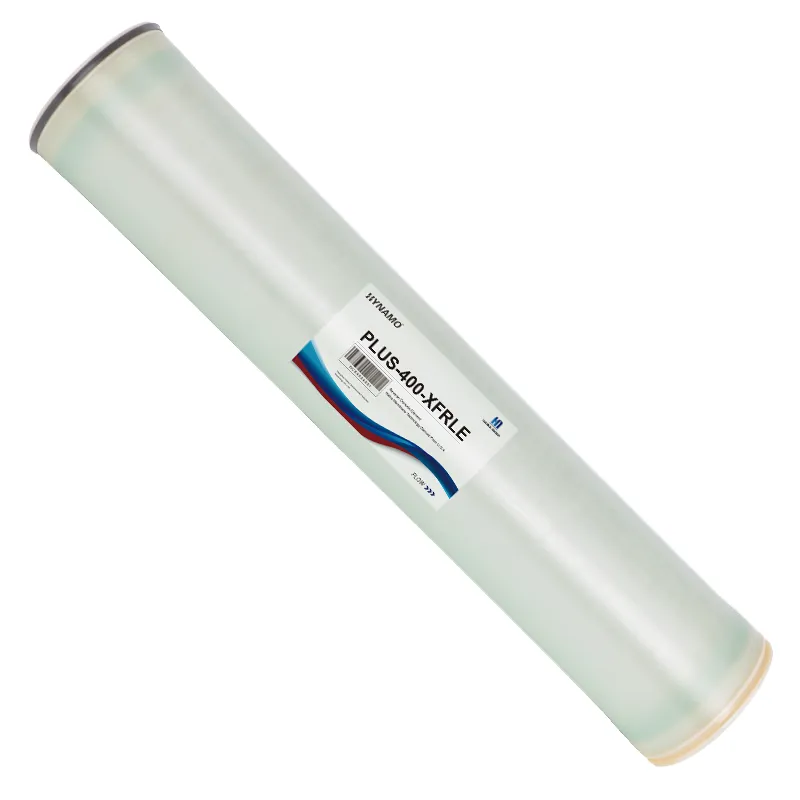
Industrial RO membrane elements adhere to consistent dimensional standards—most commonly 8-inch diameter and 40-inch length—ensuring precise fit within off-the-shelf pressure vessels. This modularity allows capacity expansion simply by adding more vessels onto shared structural racks. Each vessel accommodates up to seven elements in series, delivering predictable hydraulic behavior and compact footprint scaling. Standardized end caps, permeate ports, and manifold interfaces eliminate custom fabrication, and interconnecting piping follows widely adopted ANSI/ASME design patterns. As a result, upgrading from a single treatment train to multi-train operation requires minimal downtime and no reconfiguration of control logic—the system scales linearly, with throughput adjustments governed by well-established hydraulic ratios. This “plug-and-play” scalability transforms capacity planning from a capital-intensive overhaul into a flexible, phased investment.
Cross-OEM Compatibility with Major Skid-Mounted and Containerized Treatment Platforms
The 8040 form factor has served as the de facto industry standard for decades, enabling seamless interchangeability across skid-mounted and containerized systems from diverse OEMs. Feed- and concentrate-port configurations align with ISO-standard pressure vessels, allowing brackish-water-rated elements to operate reliably in seawater containers—and vice versa—without mechanical modification. This interoperability protects long-term capital investment: facility managers can source replacement membranes from multiple qualified suppliers, avoiding vendor lock-in. Upgrades—such as transitioning to low-energy membranes—require no changes to existing high-pressure pumps, piping, or control systems. Likewise, emergency containerized units can draw spares from nearby operational sites, cutting response time during supply disruptions. This ecosystem functions because membrane manufacturers, vessel fabricators, and skid integrators voluntarily conform to shared dimensional and interface specifications—ensuring that any compliant industrial RO membrane element reliably mates with any compatible platform.
Economic Efficiency and Sustainability Gains from Industrial RO Membrane Adoption
Higher Water Recovery (85–90%) Reducing Brine Discharge and Feedwater Demand
Industrial RO systems routinely achieve 85–90% water recovery—a significant improvement over conventional designs—directly reducing brine volume, raw water intake, and associated chemical demand. For example, a plant producing 10,000 m³/day of permeate at 90% recovery generates just 1,111 m³/day of brine, compared to 2,500 m³/day at 80% recovery—a 56% reduction in waste volume. This efficiency lowers brine disposal costs by 40–60%, according to the 2023 WaterReuse Association study, while shrinking the footprint and environmental risk of evaporation ponds or deep-well injection. Reduced freshwater abstraction also supports circular-economy objectives and regulatory compliance in water-stressed regions, enabling facilities to meet tightening discharge limits without sacrificing output or reliability.
Lower TCO: Reduced Chemical Cleaning, Extended Lifespan, and Energy-Optimized Operation
Advanced antifouling and scaling-resistant membrane surfaces significantly reduce fouling rates, lowering total cost of ownership (TCO). Per the International Water Association (2022), these innovations cut aggressive chemical cleaning frequency by up to 50%, decreasing chemical procurement, neutralization waste, and system downtime—while preserving membrane integrity. As a result, typical element service life extends to 5–7 years, up from the traditional 3–5. Simultaneously, low-energy membrane designs reduce specific energy consumption by 10–15% compared to earlier brackish-water models, per the U.S. Department of Energy (2022). These improvements compound: fewer replacements, lower chemical inventory, reduced maintenance labor, and sustained high-rejection performance collectively drive down lifecycle OPEX—making industrial RO not only technically robust but economically compelling for large-scale water treatment operations.
FAQ
What is the primary advantage of industrial RO membranes?
Industrial RO membranes provide superior contaminant rejection (>99.5% for salts and micropollutants) and operational efficiency for large-scale water treatment.
How do these membranes achieve high rejection rates?
Through advanced thin-film composite polyamide layers, negative surface charges, and steric hindrance mechanisms for precise contaminant exclusion.
How does modular design improve scalability?
Modular systems allow for plug-and-play expansion by adding pressure vessels, enabling phased investments without major system reconfiguration.
How do industrial RO systems promote sustainability?
They achieve higher recovery rates (85–90%) to reduce brine discharge, freshwater extraction, and environmental impacts, aligning with circular-economy goals.
Are industrial RO membranes compatible across systems?
Yes. Membranes adhere to standardized dimensions and interfaces, ensuring interchangeability and avoiding vendor lock-in.